
How to Improve Your Posture After 60
I’ve always believed that how we carry ourselves matters just as much as what we wear. You can be wearing the most beautiful outfit in the world, but if your shoulders are slumped and your head is pitched forward..nothing will look quite right. My posture used to be fabulous, thanks to many years of ballet training, but over the years, I’ve noticed it slipping. My chin is jutting forward, my shoulders are rounding, and my chin is dipping down. It’s always a surprise when I catch it in a reflection because it doesn’t feel like my body is doing that.
In this post, you’ll find:
- Easy posture exercises for seniors
- Simple daily habits that support spine alignment
- Helpful tools for easing back pain and tech neck
- Tips for sitting, standing, and even sleeping better

Good posture is one of those quiet things that elevates everything else. It helps your clothes hang better, gives you a more confident presence, and supports your body in all the right ways. It’s also a great way to maintain your visibility as you age. And while it might take a little more effort after 60, it’s absolutely something we can improve. Improving your posture now can help you feel stronger, look more confident, and avoid back pain down the road.
If you’re looking for more healthy aging tips, you may enjoy these posts:
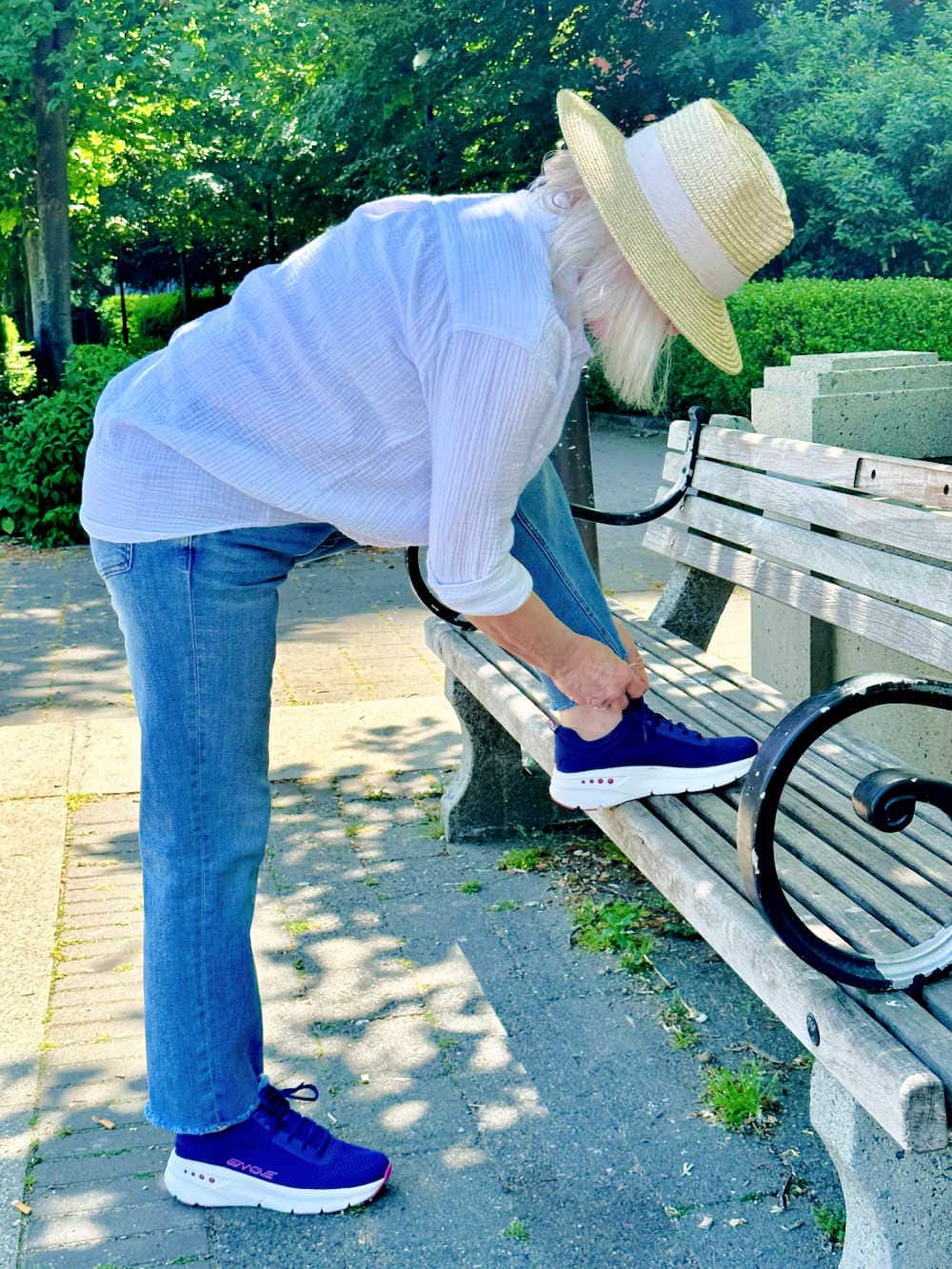
What’s Really Causing Poor Posture After 60?
For me, the first step was understanding what was going on. A few common culprits started to stand out:
- Weak core muscles – I’ve lost a bit of muscle tone over the years, especially in my abdomen and lower back, which makes it harder to support good alignment.
- Too much sitting – Whether I’m writing, reading, knitting, traveling, or on my laptop, I spend way more time seated than I should.
- Looking down at my phone – That forward tilt of the head puts so much strain on the neck. I had no idea how much until I really started paying attention.
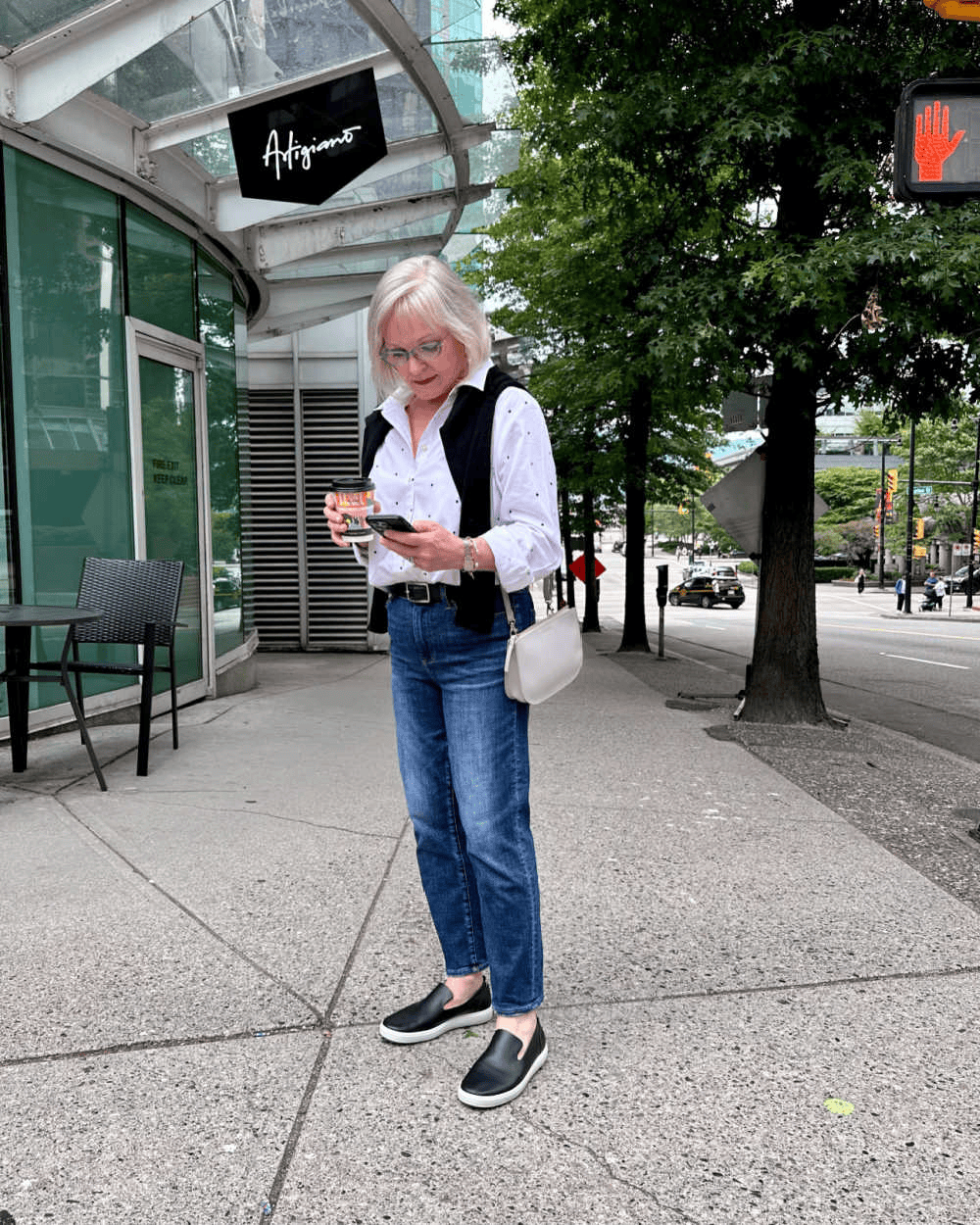
My biggest posture pitfall. Looking down at a screen isn’t always kind to alignment.
Simple Posture Tips For Women Over 60
While I’m not perfect (far from it) and don’t do these as often as I should, I know that the below things are very important.
Simply Notice
Awareness really is half the battle. I’ve started doing little “posture checks” throughout the day. In the mirror, while waiting in line, sitting at my desk. I’d gently pull my shoulders down and back, lift my chin slightly, and draw in my belly. Just enough to re-engage my core and spine.
It sounds simple, but it takes practice—and it’s made a big difference.
Easy Posture Exercises for Seniors That Actually Help
You don’t need an intense workout to improve your posture. These low-impact posture exercises for seniors are also great for building the core strength we need to stay upright, stable, and confident.
- Wall angels – Stand with your back against the wall and raise and lower your arms like you’re making a snow angel, trying to keep them in contact with the wall.
- Bird dogs – On all fours, reach out with one arm and the opposite leg, hold for a few seconds, then switch sides. Great for the core and balance.
- Planks – Start small, just 10–15 seconds on your forearms or knees, and slowly build up. They really help strengthen your midsection and improving core strength is one of the best ways seniors can support better posture and prevent back pain.
Tech Neck Exercises to Try at Home
That forward-tilting head posture (aka tech neck) sneaks up on most of us—especially after years of looking down at screens. These exercises help gently counteract that:
- Chin tucks – Sit or stand tall, gently draw your head back like you’re making a double chin. Hold for 5 seconds and repeat. It helps realign your head over your spine.
- Neck stretches – Slowly tilt your head to each side, holding for 10–15 seconds. This loosens tight muscles in the neck and shoulders.
- Wall nods – Stand with your back against the wall and nod your head slightly forward and back without lifting your chin. Subtle but effective.
These take less than five minutes and make a big difference in easing stiffness and retraining your neck position.
Stretching For Better Alignment and Flexibility
I used to think stretching was something you did after a workout. Now, I see it as essential for keeping my body feeling open and aligned. My favorites:
- Chest stretches with my hands clasped behind my back
- Gentle shoulder and neck rolls
- “Cat-cow” stretches on the floor (or even standing at the counter if my knees are cranky)
Even five minutes a day makes my body feel more awake and my posture more natural.
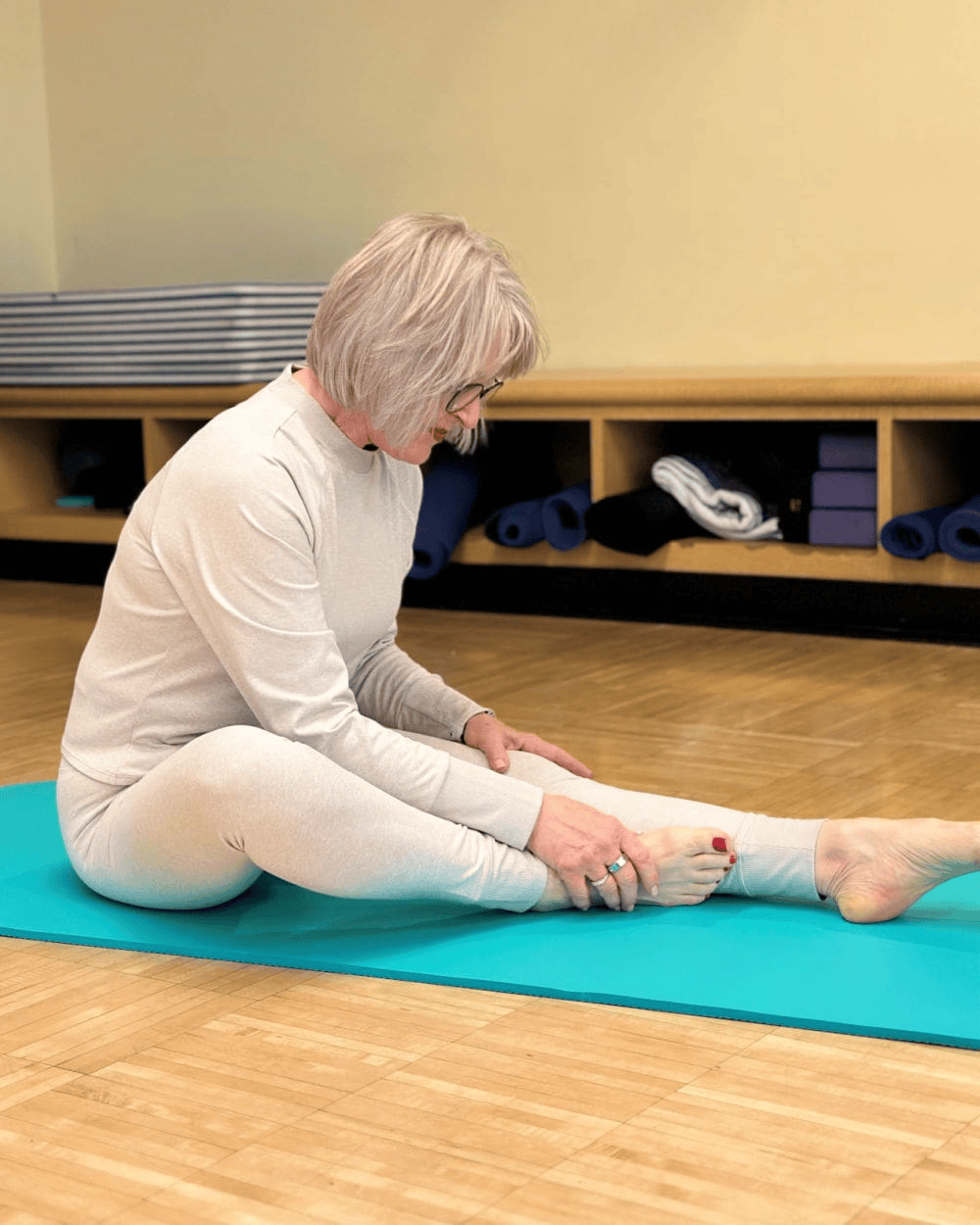
Everyday Habits That Are Sabotaging Your Posture
I also started paying attention to how I move through the day—especially when I’m doing things like reading, cooking, or working on the computer. These tweaks helped:
Sitting with support
I slipped this little lumbar pillow over the back of my desk chair, and it makes an amazing difference. I also make sure my feet are flat on the floor with my knees at a right angle. It’s easy to slouch without realizing it, so now I check in with myself often.
Uncrossing my legs
I had no idea how much crossing my legs was affecting my posture until my physical therapist convinced me to stop. Sitting with both feet on the floor helps keep my pelvis balanced and my spine straighter. Since I’m short, my feet don’t reach the floor from our couch, so I keep this little adjustable footrest in front of where I sit, and it’s really helpful for relieving lower back pain.
Getting up often
I try not to sit longer than 30 or 40 minutes without standing or walking around for a few. Sometimes I’ll stretch my arms overhead or roll my shoulders before sitting back down.
Thinking about sleep posture
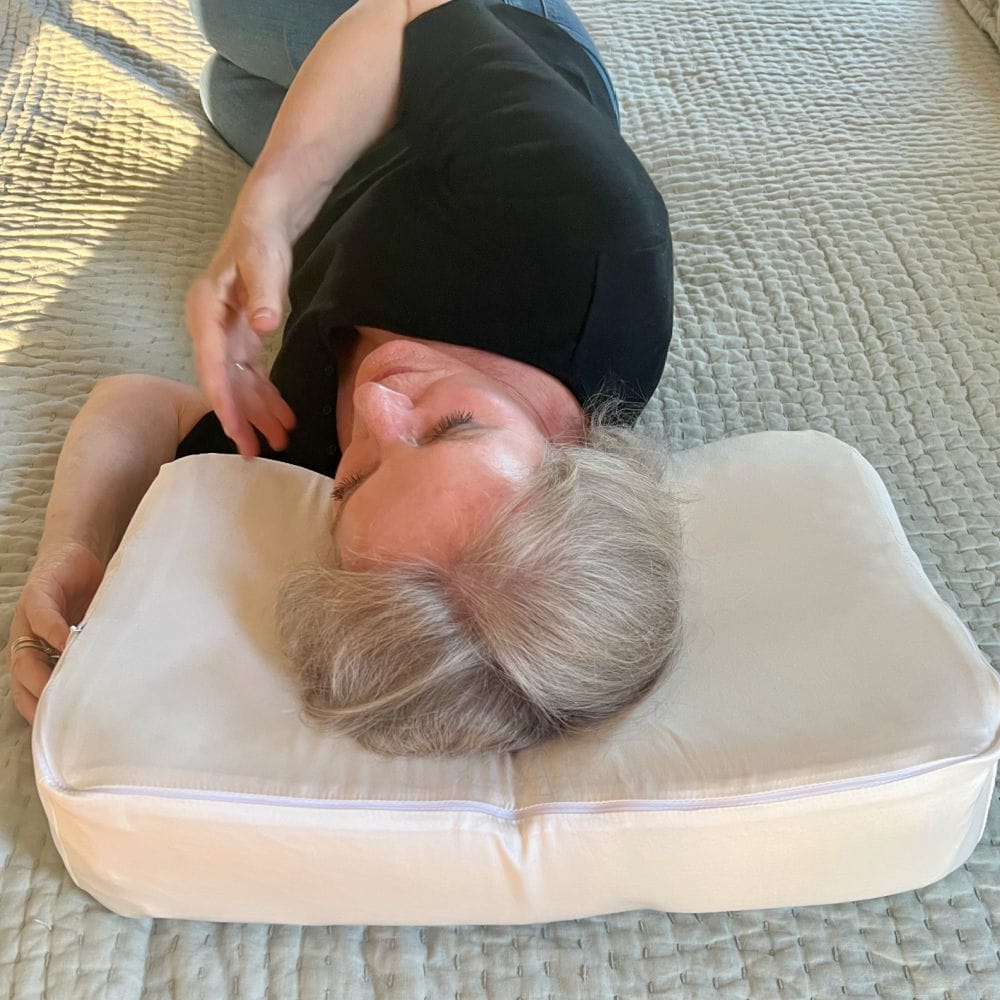
I replaced my old pillow with this envy pillow, which supports the curve of my neck. I love it so much I bought the travel size, which I use in our apartment. I also sleep with a small pillow under or between my knees, which helps my hips and lower back feel better in the morning.
The Best Tools to Help Improve Posture After 60
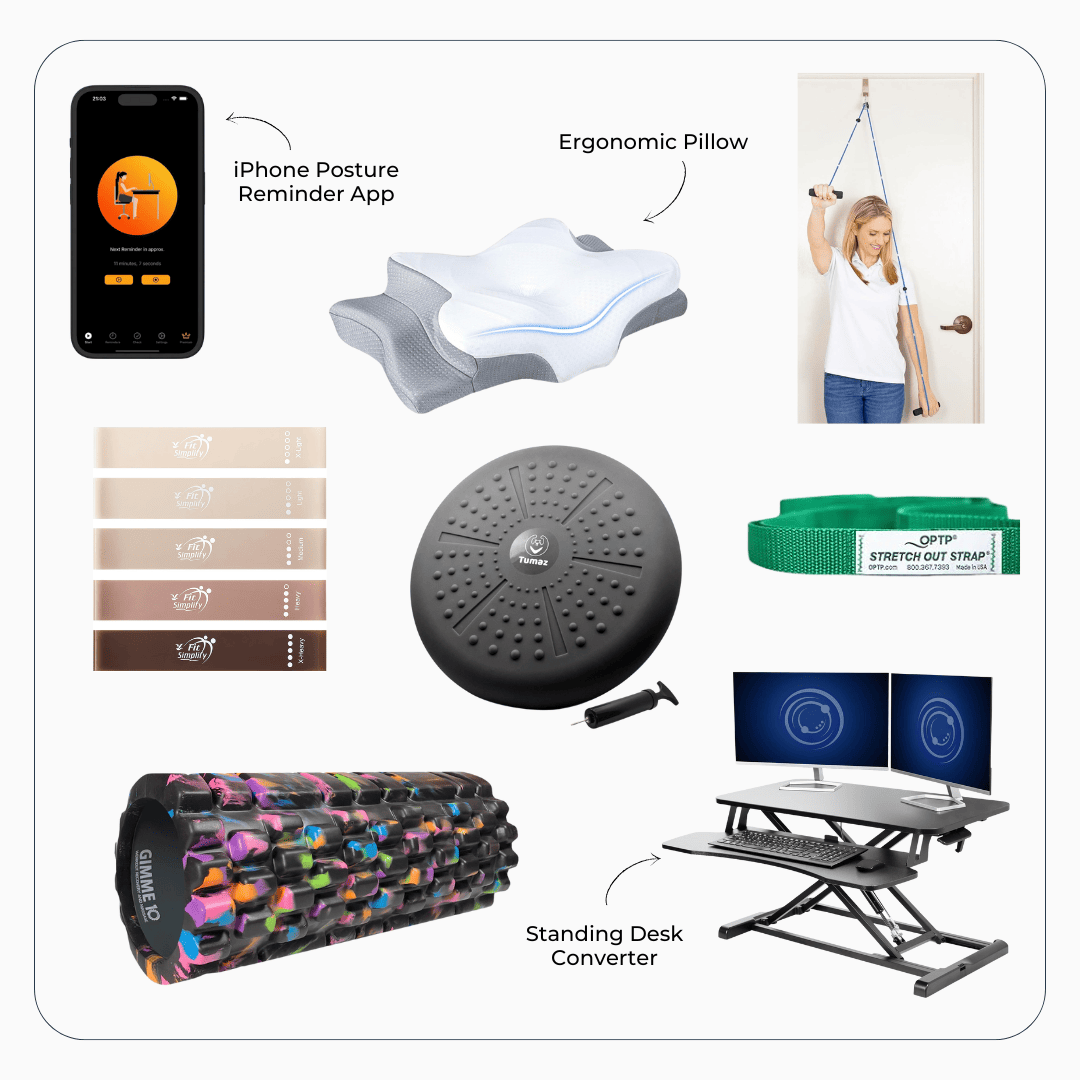
There are a few tools that can provide subtle reminders or extra support:
- Standing Desk Converters: Alternating between sitting and standing reduces back strain and helps build awareness.
- Balance Cushions: Sitting on one encourages subtle core engagement and discourages slouching.
- Stretching Straps or Foam Rollers: Great for opening tight chest and shoulder muscles at home.
- Posture Reminder Apps: There are simple apps that send gentle reminders throughout the day to check your posture. They’re especially helpful if you spend time at a desk or tend to lose track of time while reading or working.
- Doorway Stretch Tools: These tools are designed to assist with chest-opening stretches. You place them in a door frame to help gently pull the arms back and open tight chest muscles—perfect for anyone with rounded shoulders from years of desk work or driving.
- Resistance Bands: Excellent for building strength in the shoulders, upper back, and arms. Great for improving posture-supporting muscles without adding bulk.
- Mirror or Video Feedback: Using a full-length mirror or recording a short video while walking or standing can help women see what’s happening with their posture.
- Pilates or Alignment-Focused Streaming Programs: Free online classes or videos focused on posture, functional movement, or spine health can be incredibly helpful.
- Forme Power Bra is an FDA-registered posture-correcting bra engineered to immediately improve your upper body alignment and body foundation. I ordered too small a size and almost dislocated my shoulder trying to get it off, so I need to order a larger size :). I could tell it was really going to help!
More posture-correcting bras

When to See a Professional About Posture Changes
If posture is causing discomfort or beginning to affect daily movement, it’s worth checking in with a professional. A physical therapist or posture specialist can offer a fresh perspective, identify what’s really going on beneath the surface, and suggest simple, personalized exercises to help restore balance and ease. Sometimes, just a few targeted sessions can make a noticeable difference.
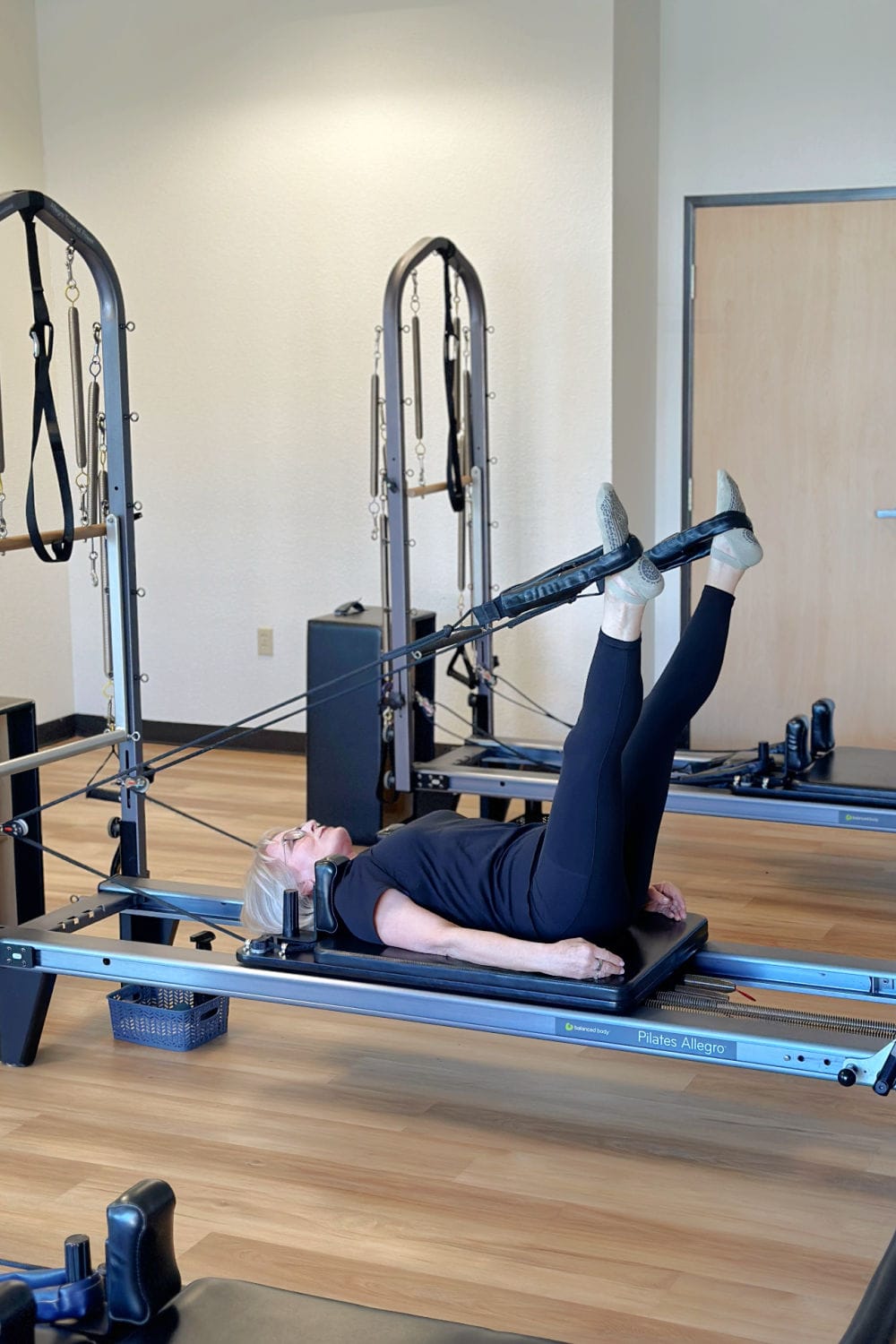
Have you been working to improve your posture? I’ve also started taking Pilates and love it! I’d love to hear what’s helping you feel more upright and aligned.
Bird dogs and planks are my friend. But I still need to remind myself not to curve my shoulders forward. Thanks for the reminder. I was sitting here hunched. But not now.
🙂
Excellent, excellent advice Jennifer and the only thing I might add is; (as Susan below suggested) if you do have osteoporosis ensure it is taken into consideration as to the exercises you choose and do. In other words if you don’t, you are more susceptible to injury. i.e.: Fractures -Brenda-
I often remind myself while driving to straighten my back, shoulders back, and raise my chin so I have better posture.
This was another very timely and important article today. There are many great tips here and I especially love the foot rest idea! I have the most comfy sofa but if I sit back straight my feet don’t touch the ground so I’m either sitting on the edge leaning forward or stuffing pillows behind my back.
I’m also encouraged to do the exercises you suggest. Thanks, Jennifer.
Couches fit my husband at 6’4″ but not me at 5’4″ 🙂
Eleven years of ballet and dance did well by me for most of my younger years. Having a very active nursing career until age 62 helped a lot. But then I managed my husband’s medical practice for five years and was at a computer most of the day. I gained weight, my posture was getting poor and I developed neck pain for that head tilted forward and shoulders rolled. At the same time I developed osteoarthritis and peripheral neuropathy. At 67 I was physically in chronic pain and disabled. I retired and have slowly pulled myself out of those terrible places with understanding my limits but using what I could do. I also deal with curvature of the spine. Now I’m 80 and my husband is 83. We walk a mile with our little dog every single day. I have neck exercises that I must do. I’m not as good to do my bands and 2 lb. Weights. Yes, that is all I’m allowed to do. My feet don’t touch the ground on any furniture as I’m only 5’1” tall but my weight is back down to normal for my age of 135-137 from 146. Walking is a great way to clear the head and enjoy the clear mountain air. Thank you Jennifer for a great post.
Thank you for being so open and honest here Sydney. Your sharing helps us all. Have a great weekend
I’ve had the PDT treatment 3 times. It really is miserable! But it does help with pre cancer and also helps cosmetically which helps me get through it. Good luck.
Thanks for your encouragement. I wish more dermatologists would recomend it as a viable alternative to cryotherapy, the Fluorouracil cream or cut and stitch Mohs.
Thanks for this great post. I just ordered the lumbar support chair pillow. Although I have a really top quality office chair, I really feel my lower back after sitting there for a while (computer, drawing, etc.). I’m hoping for some relief and reminders from this cushion.
I love that I can move mine up and down the chair too, just by tightening the strap
I noticed posture improvement after starting YouTube videos with Lauren. Her channel is called Senior Shape. She has numerous videos for all levels of yoga as well as barre and pilates. I have wondered about the Forme Bra and Envy pillow. My husband’s redness from the chemo cream faded quickly and he seems happy with the results. He also has sensitive skin. I have been interested in how your treatment is going as a comparison. His treatment was 3 weeks of redness and sensitivity. Will your treatment and symptoms be shorter? So helpful to hear our journeys as we age.
Mine will be much shorter, and I will show my results
Thanks for this great post-I certainly need to improve my posture! I’m curious about the Ryka sneakers since I’ve been on an endless search for comfortable shoes to accommodate a bunion. Thinking maybe a wide in these would work-any suggestions?
Thanks and have a great weekend.
I’ve owned several pairs of these and love the comfort.
An excellent reminder for such an important part of our physical well-being. This really hit home today. I needed it!
Thanks so much for the tips and info. Love reading all your posts Jennifer.
Writing it helped encourage me to keep at it too!
Hi Jennifer, I worked in front of a computer for my whole career, almost 50 years! While I loved my job, it took a toll on my neck, posture, and lower back. I started PT in my early 30s with limited success. But, PT for computer users improved as I aged and I finally found the exercises—stretching and strength building—that helped me. Cardio (I bought myself an elliptical machine so I have no excuses) followed by strength building with bands, light weights, and using my body as a weight. Throughout all my exercises I remain mindful of my posture. Romanian deadlifts alternating with loaded good mornings help my back (I use light weights 5-20lbs). I use stretchy bands for pull downs and rows—they really warm up, stretch out, and build up my back. This is followed by push ups, either on the floor or against the wall or back of a couch (all distracted by how I’m feeling). I then do a rotating variety of standing balance exercises. Finally, I hit the floor to work on my core. I avoid core exercises that put any strain on my neck—like sit ups. PT helped me find good substitutes. Then, on to stretching. After that , I use a foam roller, a neck peanut, and tennis ball to work on kinked up sore spots. With focus, I get this done in 45 mins to an hour every other day. It’s helped me so much! I hope this wasn’t too much to share. This has been my routine for over 5 years—when I started my neck was pitched forward and shoulders in a permanent hunch, now I can stand straight! Wishing good health and no aches to all!
Thank you so much for sharing this Terry! You’re inspiring and this workout is something we all need to be doing. I’ve been thinking I need to find a good personal trainer to get and keep me on course.
Exactly what I needed to read today. Thanks much!
Have a great Friday Nancy!
thanks for this really informative and useful post. i am conscious of my poor posture and always working towards correcting it. you’ve given me some new tools for that job.
Great post! My posture isn’t the greatest anymore either. I set reminders on my phone to check it.
Great idea.
Wow, Jennifer! You have been reading my mind! I was just looking into posture and how it relates to the dowager’s hump. Article was right on point! Also, I too am enjoying Brooke Shields autobiography immensely. It’s very inspiring and it’s comforting to know that ‘ women of a certain age’ all go through the ‘empty nest’ stage sharing similar concerns, doubts and feelings!
She’s very genuine and down to earth which I appreciate
Great post! Very helpful ideas and links. Didn’t our mothers always admonish us to “stand up straight”?😂 It does get a bit more difficult as we age.
Lol, it’s does get harder. The more I look around me the more young people I’m seeing with tech neck and bad posture. It takes work!
Thank you so much for this well thought out post. At 69 (and still working) I have found that osteopenia and scoliosis are really messing with my posture. One other thing that I am struggling with is related to sitting and typing all day. My fingers have become arthritic and I have “tennis elbow”, a ganglion cyst, and dupuytren’s contracture. I have tried everything (wrist braces, ergonomic chair, elbow support, special mouse and mouse pad) and it is only getting worse. If you have any recommendations for this I would love to hear about it.
I’m so sorry you’re dealing with that. I have arthritis, dupuytrens contracture, trigger fingers, tenosynovitis, osteopenia…and am heading back for another bone density to be sure it hasn’t progessed to oestoporosis. I had surgery for the duputrons and trigger finger…which has a disaster and often wear a brace for the tenosynovitis. Long times doing anything are not helpful. As far as I know, all we can do is break up the time working and more around. Let me know if you learn anything else we could try.
Hi Jennifer, I enjoyed the posture info. I need to pay closer attention to how I sit and stand. Your blogs are always so informative and entertaining. I subscribe to similar sites, but yours by far are the most appealing to me. Thanks.
I’m glad you like these posts Candy. We are more than what we wear so I like to include lifestyle issues many of us are facing.
This article is a great reminder. You’ve supplied so many good strategies, and I will start today to reincorporate many of them. I’ve been to physical therapy several times over years for neck and shoulder issues, and you are right on with your solutions. Somehow we get busy and forget these important foundational habits. The phone is a big culprit for me! Thank you for this post!
The mobile phone is a a problem for most of us! The ones attached to a wall with a handset attached by cord, was much easier on the body 😉
Thank you for these important reminders, Jennifer. I, too, enjoy Pilates and recommended it for core strength with one caveat. People with osteoporosis in the spine should check with their health care provider on exercises that require modifications. The trainers at my studio offer alternatives that suit my workout and my back.
My trainers do too. I always tell them about my spine and joint issues so they can guide me.
I have ignored that niggling thought that crossing my legs can have negative consequences. Thanks for a great tip!
It’s been a disaster for my spine and posture