
How To Find Your Personal Contrast Level And Why It Matters
A reader wrote in with a question. I get more than you’d think. She’d gone gray and noticed that some colors in her seasonal palette were suddenly working better than others. She wanted to know if there was a formula she could use to sort it all out.
There is, and it starts with contrast.
Most people focus on finding the right colors for their complexion, which makes sense. But your personal contrast level is just as important, and it’s often the missing piece when an outfit feels a little off, but you can’t quite put your finger on why.
Before we get into how to find yours, it helps to understand how color actually works. Every color has three components. Hue is the color itself, think red, yellow, blue. Value is how light or dark that color is. Saturation is the intensity or purity of the color. All three play a role in whether a color combination flatters you or flattens you.

Our hair color, skin, and eyes all have a value (light to dark) on a sliding scale. Our personal contrast level is the difference between them. Wearing contrast levels that match your own contrast levels is as important as whether the undertone is warm or cool. In some instances, it’s more important!
High contrast is when there’s a large difference in the lightness of one or more colors. For example, if you have very dark hair and light blue eyes, you have a high-value contrast. However, if your dark-colored hair has gone a medium grey, it will lower the difference (contrast) with your eyes. As our hair goes gray or silver, our personal contrast level will shift.
If you have light silver or blonde hair, fair skin, and pale eyes, you have a low contrast value and will look best in low-contrast outfits. Medium value contrast is when there’s a difference, but it’s not extreme.
Contrast levels that are too strong overpower and wash you out. Conversely, wearing a contrast that is too low reduces your visibility. Knowing and wearing outfits that echo your personal contrast levels keeps you looking vibrant and visible at a time when society often overlooks midlife women.
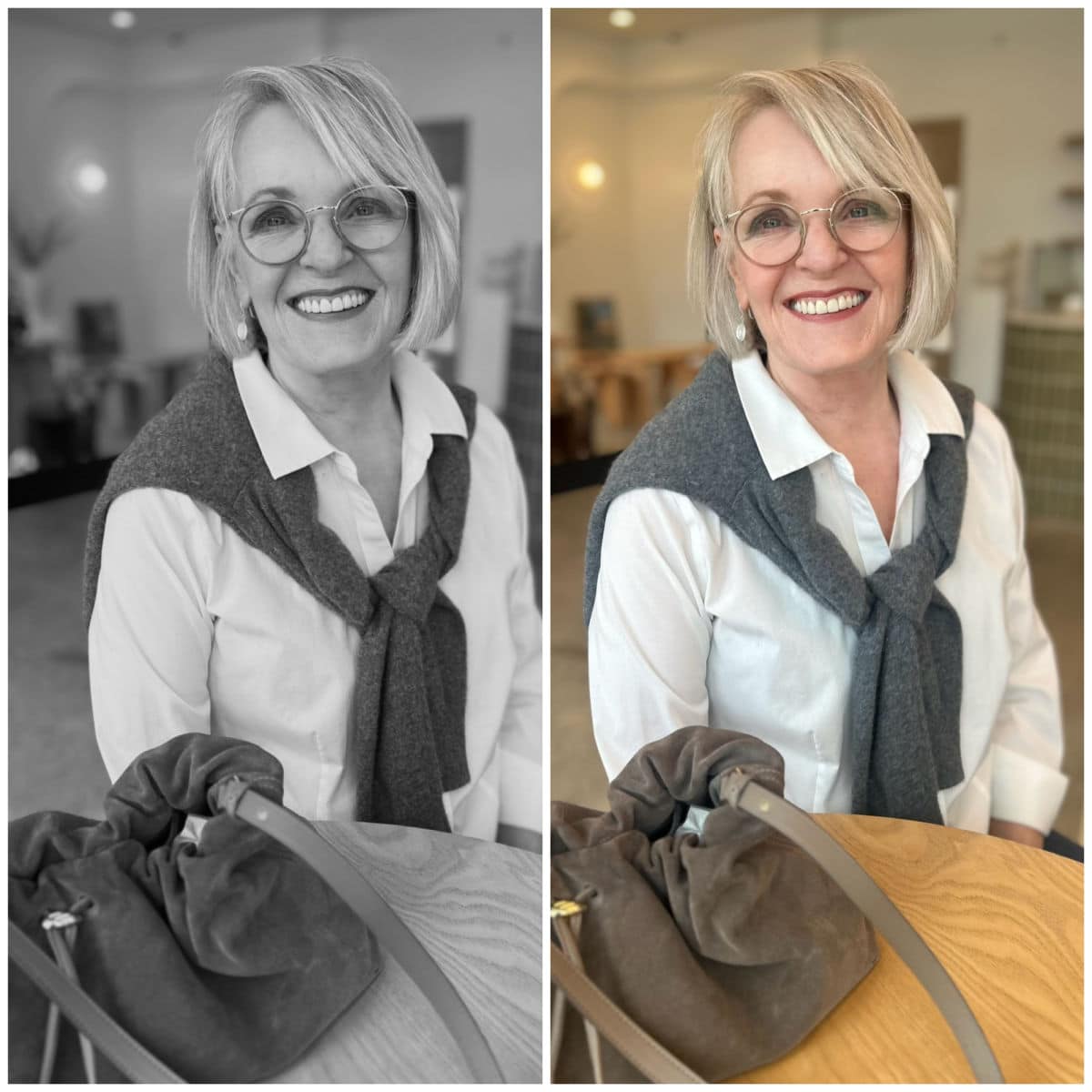
How to find your personal contrast level
The easiest way to see your inherent color contrast is to take photos of your face and hair. Then, use the settings on your phone to change it to a grayscale, monotone image. Now you’ll see the difference in the intensity of your hair, eyes, and skin. I have makeup on in my photos, but you can still see the difference.
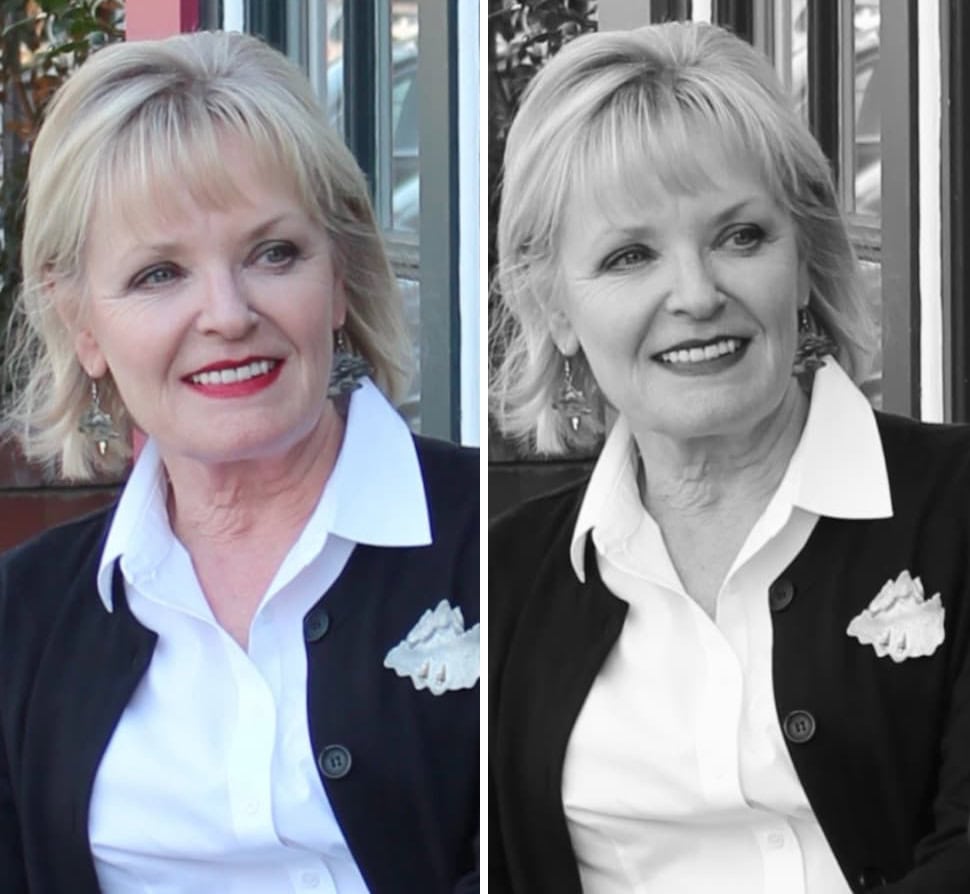
The black and white have a strong contrast that overpowers me. The red lipstick attempts to make it flattering, but falls short in the monochrome image. The black jacket is intense against my complexion. Its contrast with the white shirt draws your eye to the garments rather than to my face.
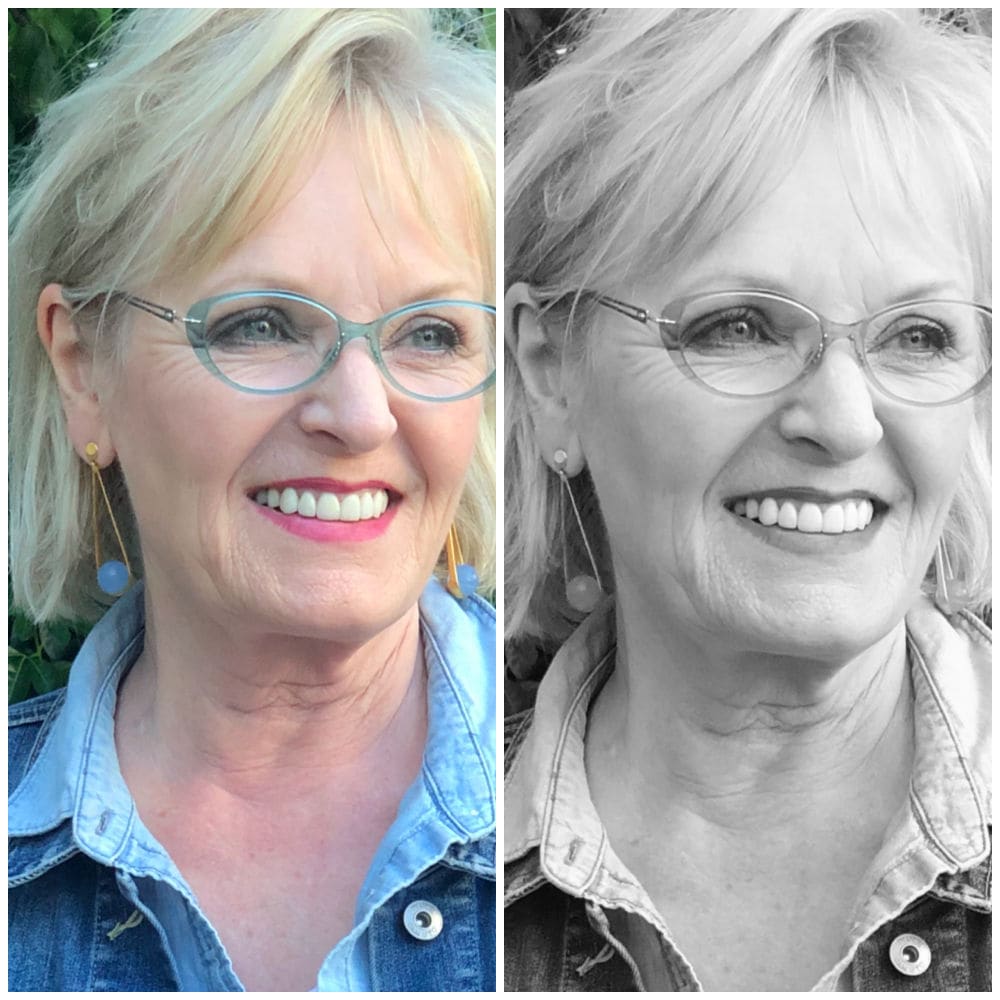
In this photo, I have highlighted pale ash blonde hair. Along with my fair skin and medium eyes, I have low-to-medium contrast values that match the chambray shirt and denim jacket. My eyeglass frames and lipstick are also a low contrast, which doesn’t overpower my coloring. My low intensity is also why I am flattered by monochromatic outfits, as they are the epitome of low contrast.
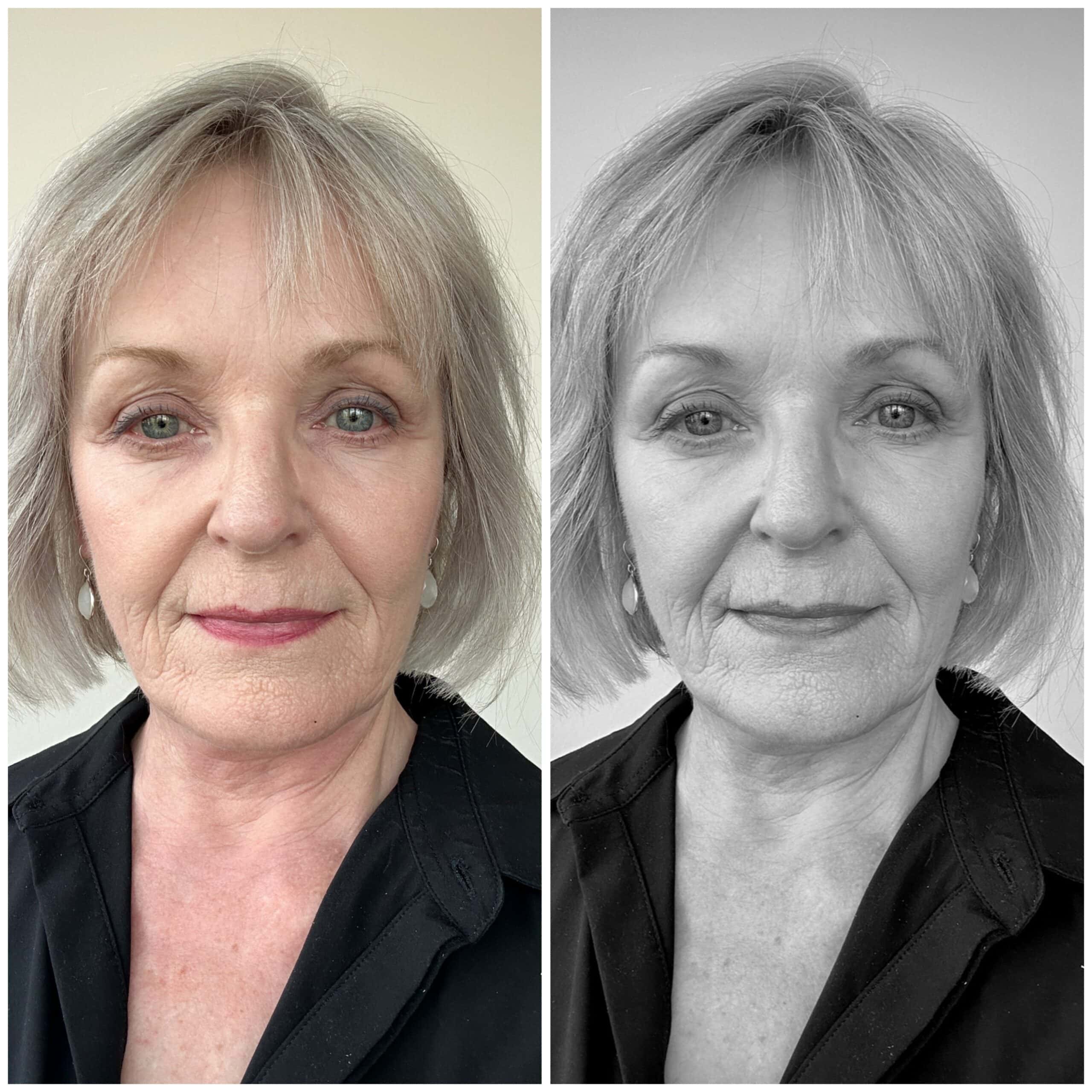
Since I’ve let my hair go natural (silvery), the contrast between my hair and eyes has become even softer than when I was highlighting it. This black shirt looks even starker against my low contrast coloring, so my head looks like it’s floating.
Below is another example using outfits. The same sweater with different-wash jeans is a great example. High contrast is when there’s a big difference between one or more colors. Low contrast is when they’re very similar. Medium contrast is when there’s a difference between them, but it’s not extreme.
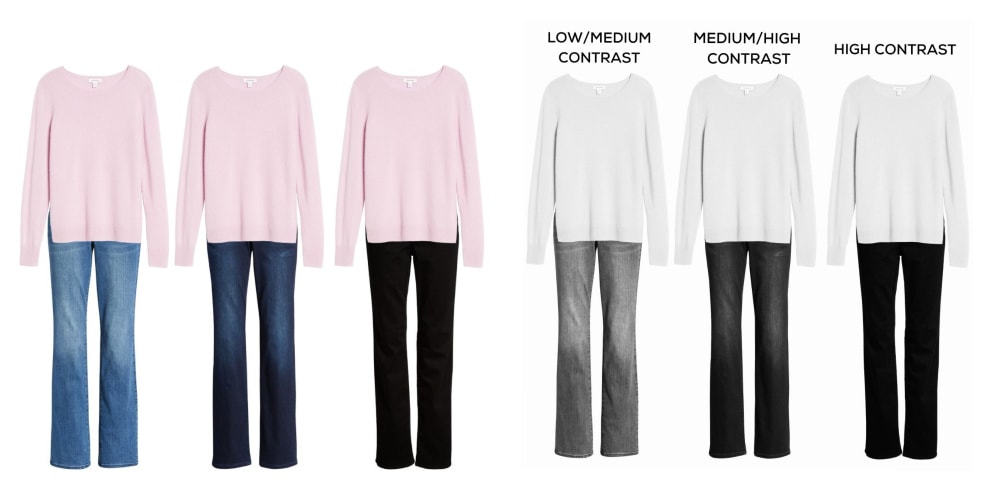
When we remove the color, you can see the contrast levels. The light sweater and deep-wash jeans have a high contrast, which would flatter someone with equally high contrast. If you have white hair and deep brown eyes, you can wear a stronger contrast.
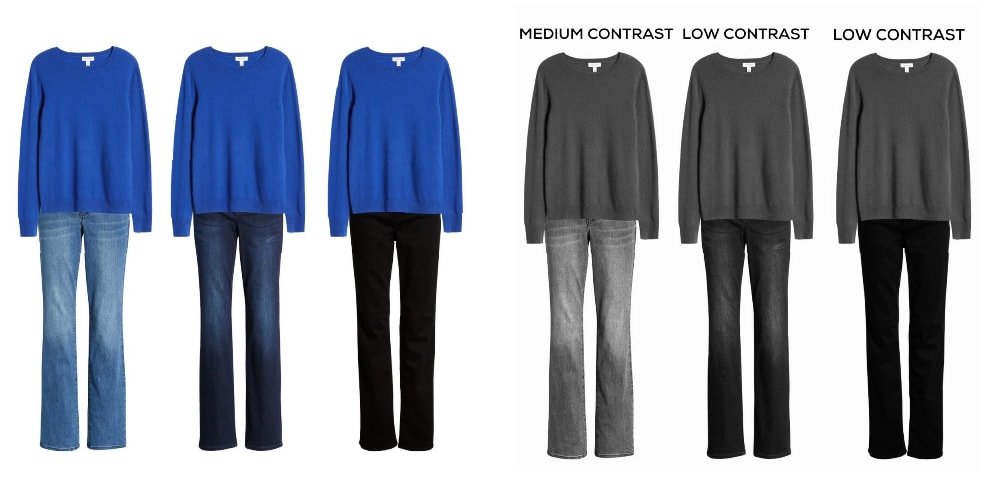
Now let’s try a deeper sweater with the same jeans.
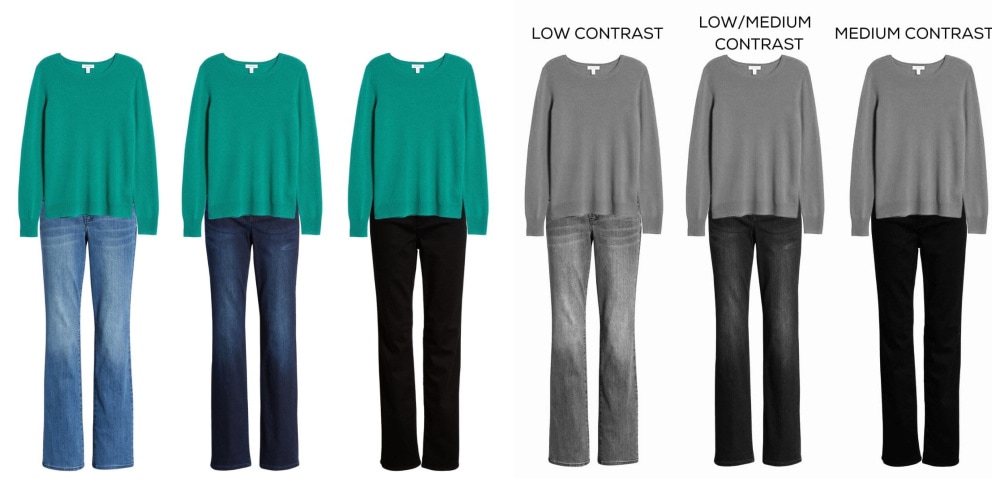
Now here’s a sweater with a medium value and the same jeans.
Try this yourself. Do all the grays meld softly, or do your eyes stand out? Is your hair noticeably darker than your skin tone? The comparison is what shows your personal contrast level. With practice, you’ll learn to recognize the contrast levels in outfits so you can wear ones that match your own. These will be the most flattering, so you’ll look the most vibrant and visible.
Hair that changes from black to pale gray lessens your personal contrast level, so you will look better in color combinations with lower contrast. You may also look better wearing the lighter colors within your palette. Remember, you will not change seasons, just the colors that flatter you most within those seasons…unless you were mistyped in the first place.
Do you pay attention to contrast levels in your outfits?
Thanks for reading, and remember to wear what makes you feel confident.
Great info in this post!
For redheads, the shift in contrast throughout our lives can be quite dramatic. This is where I get caught up. The shift from strawberry blonde hair to coppery to dark auburn back to blonde to white was gradual at points but rapid at others. At 50% grey, it was as if I woke up and none of my clothes looked right anymore. Redheads like me never go completely grey, though. There’s always some blonde. My point is that if you’re a redhead, your contrast levels may need reassessment often throughout your life, and more so on the later part of the journey.
My safest bet is to stick to medium value colors and low contrast. Too much or too little value is tricky. I do wear lower value colors in the summer months but can’t stray from my spring color palette. Very tricky indeed.
This is such a great post and an understandable explanation. I’ve always been a high contrast person, but I’ve noticed lately that I am drifting to lower, at least medium, per choice. Now I understand why! Thanks so much.
Such great information! It’s so meaningful when you can apply a label to a concept! To answer your question, I never realized that I paid attention to contrast levels, but now that you’ve explained it, I see that I’ve been doing that-just didn’t know why! Guess I’m in the high contrast category, but sometimes low with monotones; never a fan of light blue or royal blue with dark blue, for example. Love the color photos vs. black and white ones to really see the difference. Thank you for such a valuable lesson!