
How To Find Your Personal Contrast Level And Why It Matters
A reader wrote in with a question. I get more than you’d think. She’d gone gray and noticed that some colors in her seasonal palette were suddenly working better than others. She wanted to know if there was a formula she could use to sort it all out.
There is, and it starts with contrast.
Most people focus on finding the right colors for their complexion, which makes sense. But your personal contrast level is just as important, and it’s often the missing piece when an outfit feels a little off, but you can’t quite put your finger on why.
Before we get into how to find yours, it helps to understand how color actually works. Every color has three components. Hue is the color itself, think red, yellow, blue. Value is how light or dark that color is. Saturation is the intensity or purity of the color. All three play a role in whether a color combination flatters you or flattens you.

Our hair color, skin, and eyes all have a value (light to dark) on a sliding scale. Our personal contrast level is the difference between them. Wearing contrast levels that match your own contrast levels is as important as whether the undertone is warm or cool. In some instances, it’s more important!
High contrast is when there’s a large difference in the lightness of one or more colors. For example, if you have very dark hair and light blue eyes, you have a high-value contrast. However, if your dark-colored hair has gone a medium grey, it will lower the difference (contrast) with your eyes. As our hair goes gray or silver, our personal contrast level will shift.
If you have light silver or blonde hair, fair skin, and pale eyes, you have a low contrast value and will look best in low-contrast outfits. Medium value contrast is when there’s a difference, but it’s not extreme.
Contrast levels that are too strong overpower and wash you out. Conversely, wearing a contrast that is too low reduces your visibility. Knowing and wearing outfits that echo your personal contrast levels keeps you looking vibrant and visible at a time when society often overlooks midlife women.
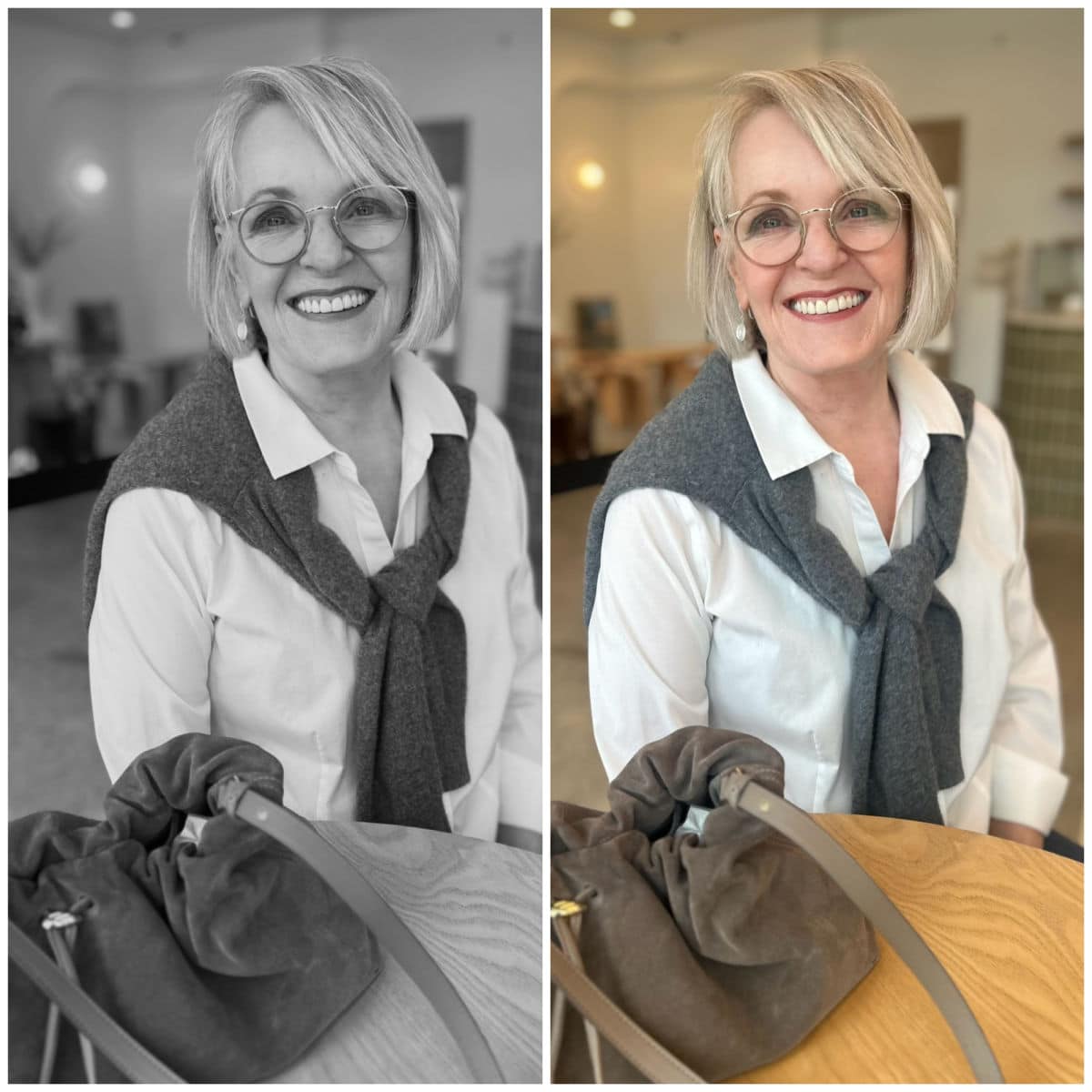
How to find your personal contrast level
The easiest way to see your inherent color contrast is to take photos of your face and hair. Then, use the settings on your phone to change it to a grayscale, monotone image. Now you’ll see the difference in the intensity of your hair, eyes, and skin. I have makeup on in my photos, but you can still see the difference.
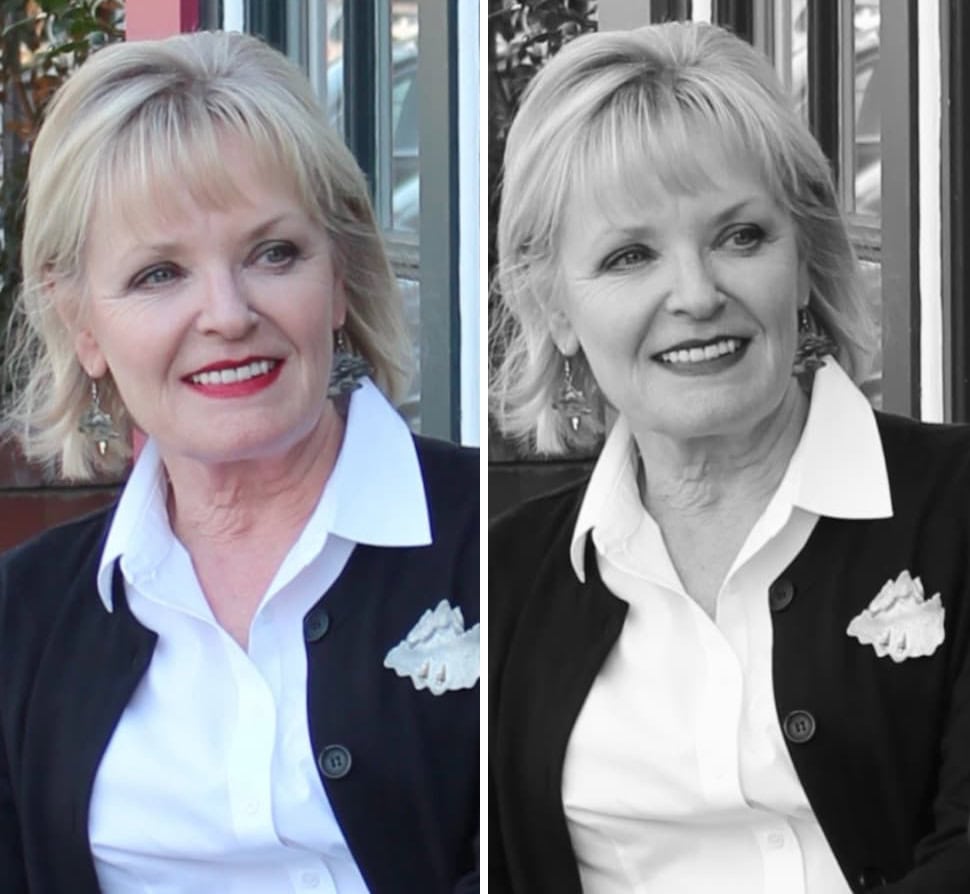
The black and white have a strong contrast that overpowers me. The red lipstick attempts to make it flattering, but falls short in the monochrome image. The black jacket is intense against my complexion. Its contrast with the white shirt draws your eye to the garments rather than to my face.
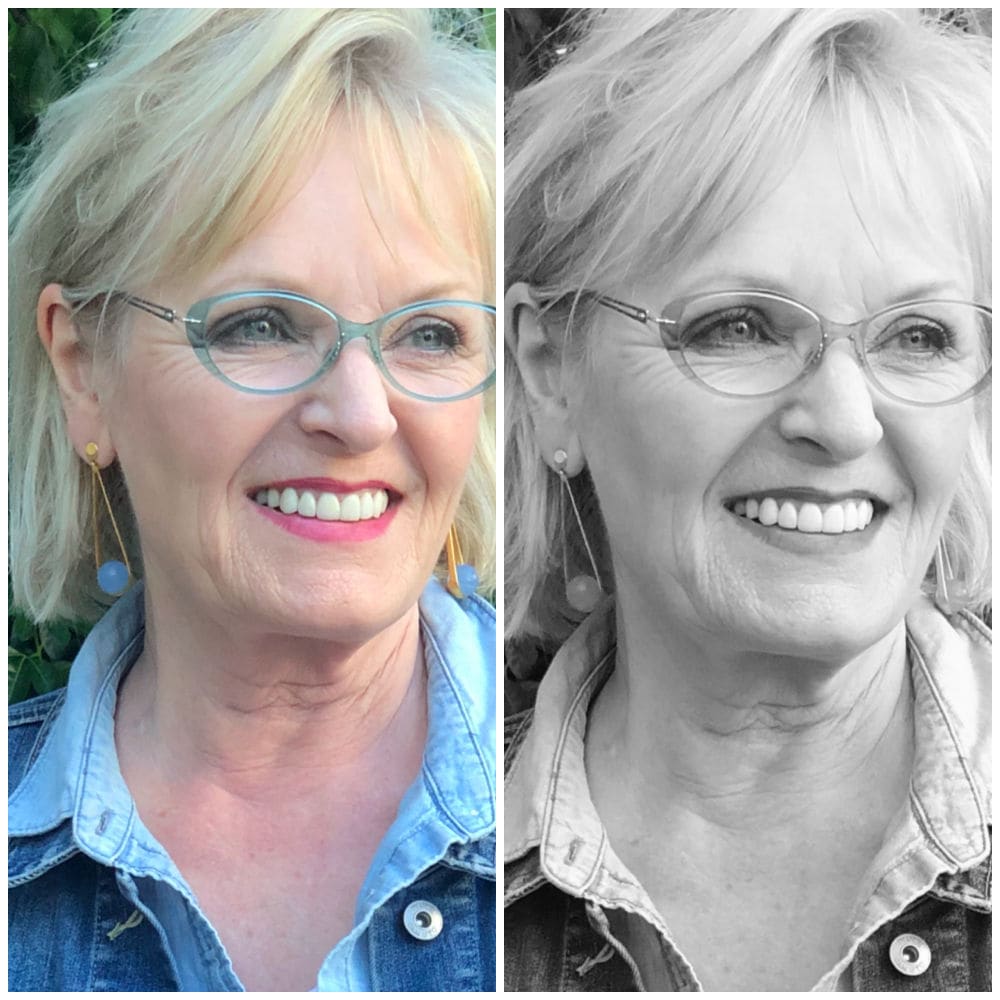
In this photo, I have highlighted pale ash blonde hair. Along with my fair skin and medium eyes, I have low-to-medium contrast values that match the chambray shirt and denim jacket. My eyeglass frames and lipstick are also a low contrast, which doesn’t overpower my coloring. My low intensity is also why I am flattered by monochromatic outfits, as they are the epitome of low contrast.
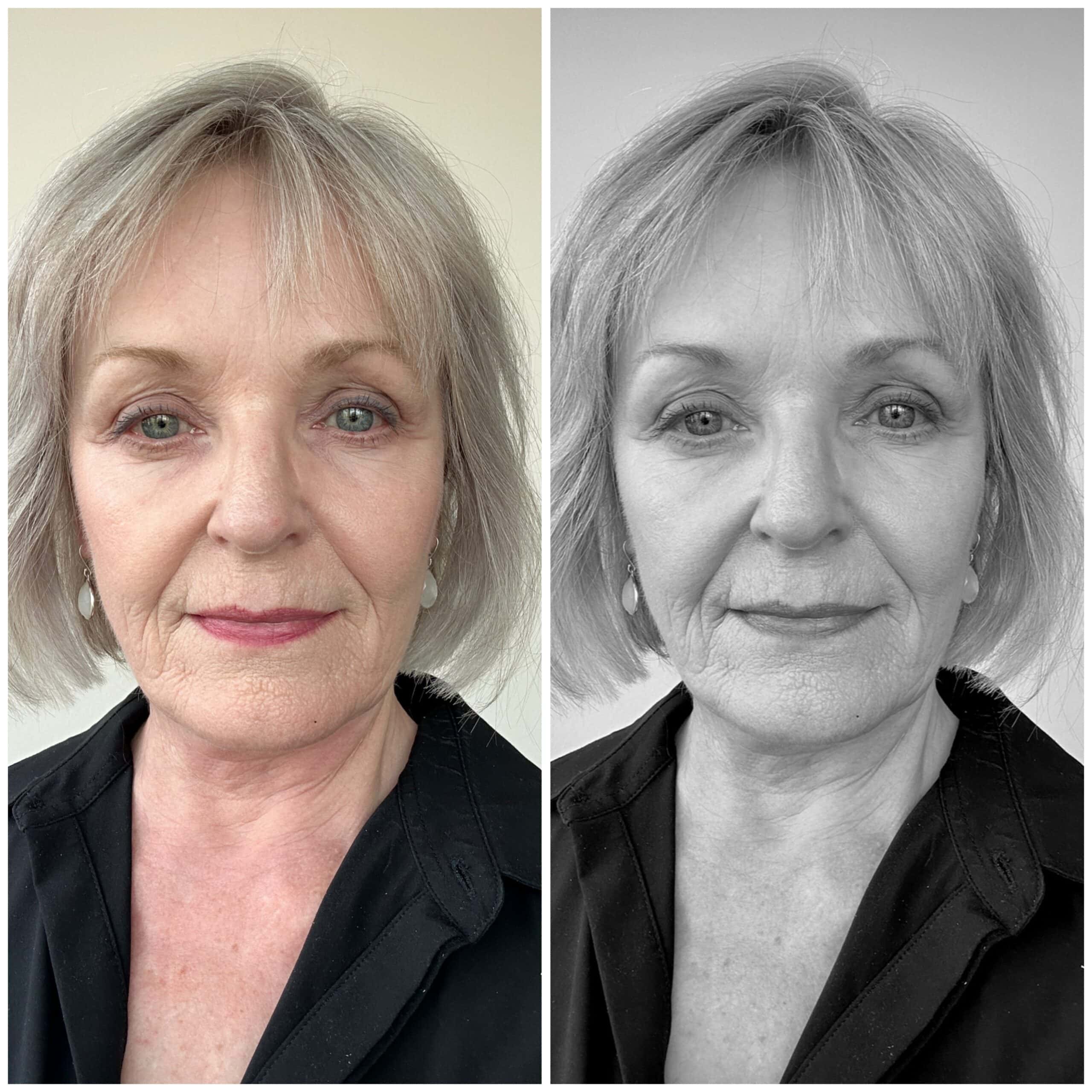
Since I’ve let my hair go natural (silvery), the contrast between my hair and eyes has become even softer than when I was highlighting it. This black shirt looks even starker against my low contrast coloring, so my head looks like it’s floating.
Below is another example using outfits. The same sweater with different-wash jeans is a great example. High contrast is when there’s a big difference between one or more colors. Low contrast is when they’re very similar. Medium contrast is when there’s a difference between them, but it’s not extreme.
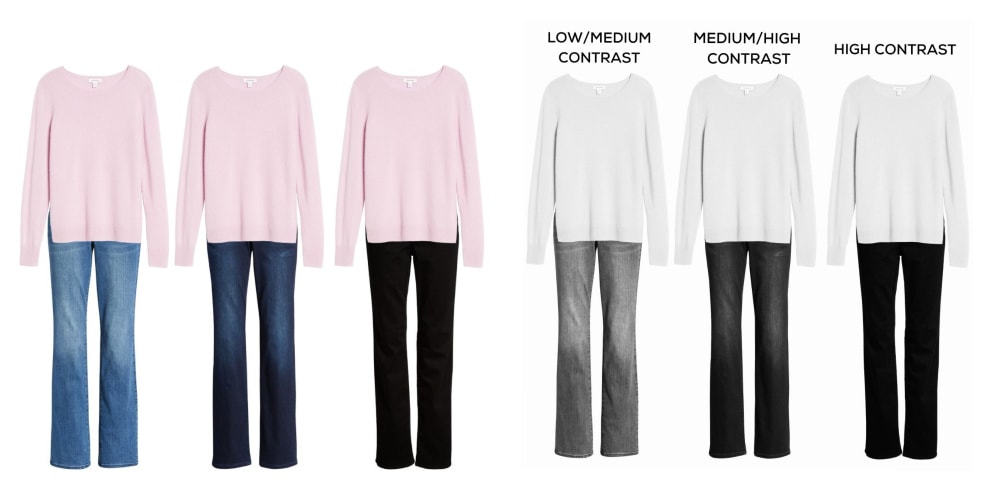
When we remove the color, you can see the contrast levels. The light sweater and deep-wash jeans have a high contrast, which would flatter someone with equally high contrast. If you have white hair and deep brown eyes, you can wear a stronger contrast.
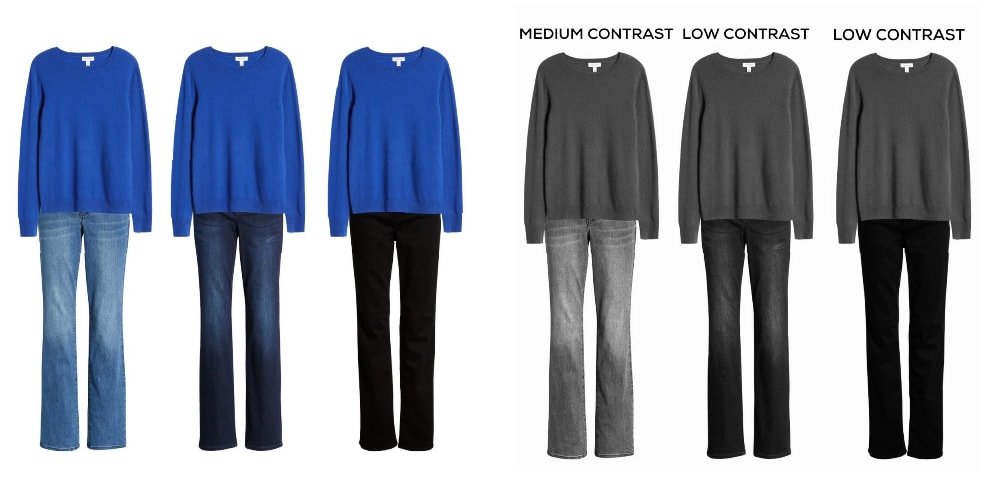
Now let’s try a deeper sweater with the same jeans.
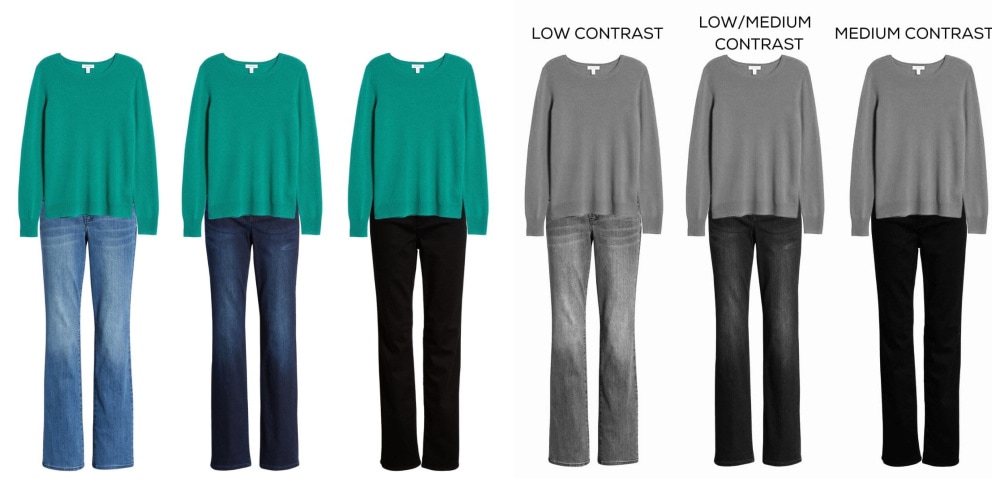
Now here’s a sweater with a medium value and the same jeans.
Try this yourself. Do all the grays meld softly, or do your eyes stand out? Is your hair noticeably darker than your skin tone? The comparison is what shows your personal contrast level. With practice, you’ll learn to recognize the contrast levels in outfits so you can wear ones that match your own. These will be the most flattering, so you’ll look the most vibrant and visible.
Hair that changes from black to pale gray lessens your personal contrast level, so you will look better in color combinations with lower contrast. You may also look better wearing the lighter colors within your palette. Remember, you will not change seasons, just the colors that flatter you most within those seasons…unless you were mistyped in the first place.
Do you pay attention to contrast levels in your outfits?
Thanks for reading, and remember to wear what makes you feel confident.
This is such an interesting post. I have been wondering why I have been looking so pale on zoom meetings. Today I wore a darker hued, burgundy sweater and I looked much more vibrant. I have pale complexion, blue eyes and silver hair. Something to pay attention to. I was blaming the lighting in my office. Thank you for the suggestions!
I’m happy it pointed you in a good direction
This sounds like just one more thing to worry about. I will continue to wear what I like without over thinking it.
Nothing to worry about, I just like knowing:)
Thank you so much for this very informative post and it’s wonderfully clear examples. Knowing what season my coloring was helped me immensely for many years. When I stopped coloring my hair last year due to Covid, I was at a total loss as to what would work with my now pure white hair. Your post has helped a great deal, given me some much needed confidence, and saved my budget too! Thank you for covering this fascinating and very helpful topic.
I’m so glad you found this helpful!!
Jennifer, thank you for the post. I found it very enlightening. I have deep copper hair and a typical redheads complexion; alabaster skin, blue eyes. I now appreciate that I am high contrast.
Julianne Moore was featured in a magazine years ago and they described her high contrast as a striking palette- I like that too.
Happy Holidays, I love your blog!
Your coloring sounds glorious!! Happy Holidays, Cynthia
This is so interesting! I think it will take me some time to figure out my own contrast. Great tip, using the phone’s camera or computer editing. Thank you.
Thank you for all this info; color has always been so interesting to me.
I have ashy-blonde hair and med blue eyes so winter colors ( true red, black and white) wash me out.
I can’t wait for Spring and Summer to come back around so I can find some flattering shades!
I don’t think I understand. I have salt and pepper hair with very dark brown eyes. Should my tops and pants be close to the same color??
It sounds like you may be medium contrast depending on your skin. Try the black and white photo test and feel free to email it to me to have a look for you.
Wow!! I didn’t know any of that before! The depth of information you provide for us followers is astounding! Thank you for caring. 🤗
Love this post. I have always had muted colouring but it’s even more of a consideration since I went gray and my skin colour has faded. I look better in softer colours so the contrast is not so stark.
Thanks. This post was very helpful. Maybe for a future post you could explore how different contrast levels affect body types, like a light contrast top/dark contrast bottom vs. dark contrast top/light contrast bottom, etc. You know, darker colors to minimize certain body features, while lighter colors maximize other areas. Example: white sweater and navy pants vs. navy sweater and white pants.
Also, I am always interested in your posts on color analysis. I don’t feel like I totally fit into one season.
That’s a great suggestion. I have some interviews upcoming that you may really enjoy. Different systems may type you into different systems, but the color swatches should have similarity if the analyst types you correctly and that takes skill on their part.
Jennifer,
I used to have dark brown eyes that have faded to medium, medium skin tone, silvery gray hair. Hair used to be dark brown.
I am 68. Do I sound like a medium contrast?? I recently lost weight due to a illness & need new clothes. Thanks
There is so much to consider when talking about the level of color contrast that works for each of us. My once short, dark brown hair is now a very light golden brown and shoulder length. The bolder makeup that I once wore is replaced with soft neutrals. NO black eyeliner for me anymore. It only holds true that my clothing choices have changed too. No bright white but soft, creamy white and much less black. The trick is to add a bit of color . I find myself reaching for fun accessories to add a touch of interest.
Wow! Great information! Something I had never thought about or considered before. Thank you.
Thank you!
This exercise turning the photo to grayscale is so illuminating. I had medium brown hair with reddish overtones (my own), which is now silver white, and nearly black eyes. The photo exercise is showing how more contrast is okay now–it balances my eyes. It wasn’t so before, and the autumnal colors I favored aren’t so good any more. I gravitate more to stronger hues, even black and white.
I am having trouble with jewelry. I do well with David Yurman silver, which is darker, but not brighter Dean Davidson. Gold is iffy.
You might also like Lagos which has similar contrast
So interesting. You have just put into words something I’ve known by instinct
for a long time. I’m a faded strawberry blonde with fair skin and medium blue eyes.
Black pants and light coloured sweaters look wrong on me and now I know why.
Very interesting – thanks!
My hair is medium gray and my eyes brown with medium skin tone. I’ve always been a winter. Do you think red still works for me? I’ll have to try this
I’m sure red works for you. It will depend on the intensity.
Wow! This is really helpful, and it’s something I’ve never considered. Perhaps this is why some things look different on me than they used to due to my graying hair. Thanks!
I’ve thought a lot about color and am sold on the “season” approach, but I’ve never thought about contrast. Intuitively I think I’ve considered this without realizing it, but now I will pay much more attention to contrast. Thanks so much Jennifer!
This is great information to know! You have a clear explanation with photos that have definitely helped me!
Thank you!!!!
Awesome!